BRAND
Journal 02 - Prada X OMA/AMO / A Shared Spatial Language
RESEARCH
How can architecture contribute to the identity of a fashion brand?
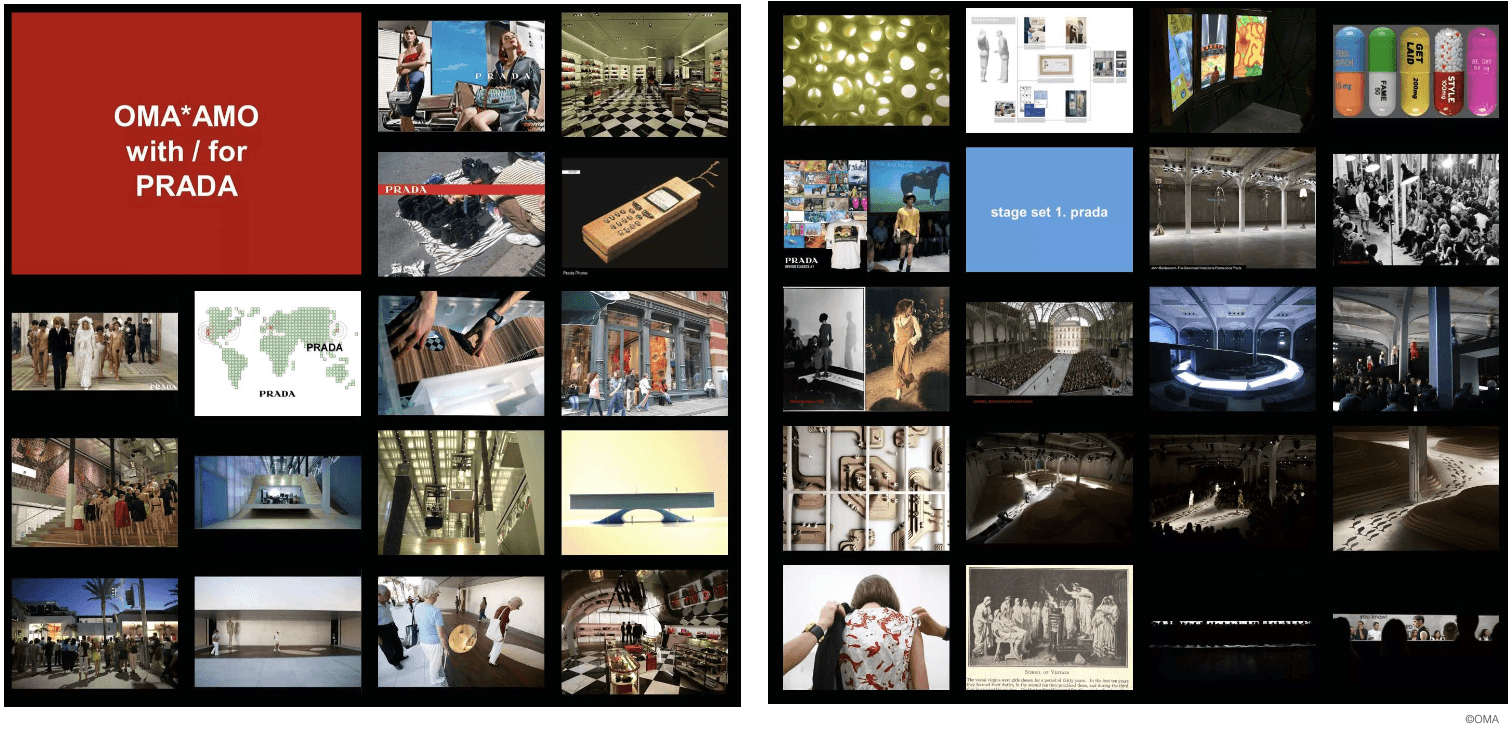
The long-standing collaboration between Prada and OMA/AMO offers a particularly interesting case through which to examine this relationship. Across different seasons, the sets appear radically different: grids, hills, waves, labyrinths, cages, tilted planes, theatrical structures and existing architectural shells. Yet beneath this formal diversity, a recurring spatial language begins to emerge.
The question is therefore not simply why each Prada show looks different, but what remains constant when the architecture keeps changing.
Diagram Sketch of Prada 2020 F/W Fashion Show and Prada Epicenter in Los Angeles

BEYOND THE COLLABORATION
The relationship between Prada's temporary fashion-show environments and OMA's permanent architectural projects reveals another layer of the collaboration.
The same architectural ideas appear to circulate between temporary and permanent projects, between fashion, retail, interiors and architecture.
The distinction between the ephemeral and the permanent therefore becomes less absolute.
They can be understood as different speeds of the same architectural research.
The fashion show provides a particularly fast and temporary environment in which an idea can be tested, experienced and abandoned within minutes. Permanent architecture operates on a slower timescale, requiring greater material, economic and structural commitment.
The temporary project can therefore act as a laboratory for architectural experimentation.
An idea does not necessarily begin as a building. It can first appear as a temporary spatial experiment.

Similarity between different Projects of Rem Koolhaas
ARCHITECTURE X BRAND
This raises a broader question about the relationship between architecture and brand identity.
If every Prada show were based on the same visual language, its identity would be easy to recognise but potentially limited by repetition.
Instead, the Prada–OMA/AMO collaboration suggests another model:
consistency through transformation rather than consistency through repetition.
The identity of the brand does not depend on reproducing a fixed architectural image. It emerges through a recurring attitude towards experimentation, contradiction, spatial manipulation and the questioning of established conventions.
The architecture therefore does not simply represent Prada.
It performs its identity.
CONCLUSION
The study of Prada and OMA/AMO suggests that the architectural identity of a brand does not necessarily reside in a recognisable form, material palette or recurring visual image.
It can reside in a method of producing space.
The most significant consistency in the Prada–OMA/AMO collaboration is therefore not found in what is repeated, but in how ideas are continuously transformed.
JOURNAL 02
PRADA × OMA/AMO
A Shared Spatial Language
Research: Architecture × Brand / Fashion / Spatial Identity / Temporary Architecture
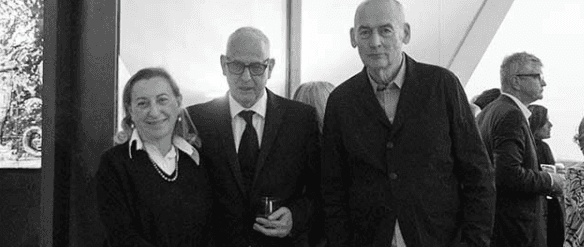
Miuccia Prada (Left), Luc Tuyman (Center), Rem Koolhaas (Right)