SHOWS
Journal 01 - PRADA × OMA/AMO / The set as an Architectural Laboratory
RESEARCH
How does a brand remain spatially recognisable when its architecture keeps changing?
Fashion shows are among the most temporary forms of architecture. Designed to exist for only a few minutes, they nevertheless construct complete environments in which bodies move, audiences gather, products are presented and a brand is experienced.

PRADA FW 2021 RUNWAY SET
BEYOND THE COLLECTION
A fashion show set is often understood as a visual extension of the collection: the clothes establish a mood and the architecture translates that mood into space.
The Prada–OMA/AMO collaboration suggests a different approach.
Rather than designing a space that illustrates the collection, the set appears to operate as an architectural problem in its own right. The runway, audience, backstage, lighting, circulation and existing architectural conditions form a programme that must be organised and manipulated.
The central questions become spatial:
How do bodies move?
Where does the audience sit?
Who is watching and who is being watched?
How is the runway experienced?
What happens when the conventional relationship between stage and audience is altered?
The collection is therefore not necessarily translated directly into form. Instead, the architecture establishes the conditions through which the collection is seen and experienced.
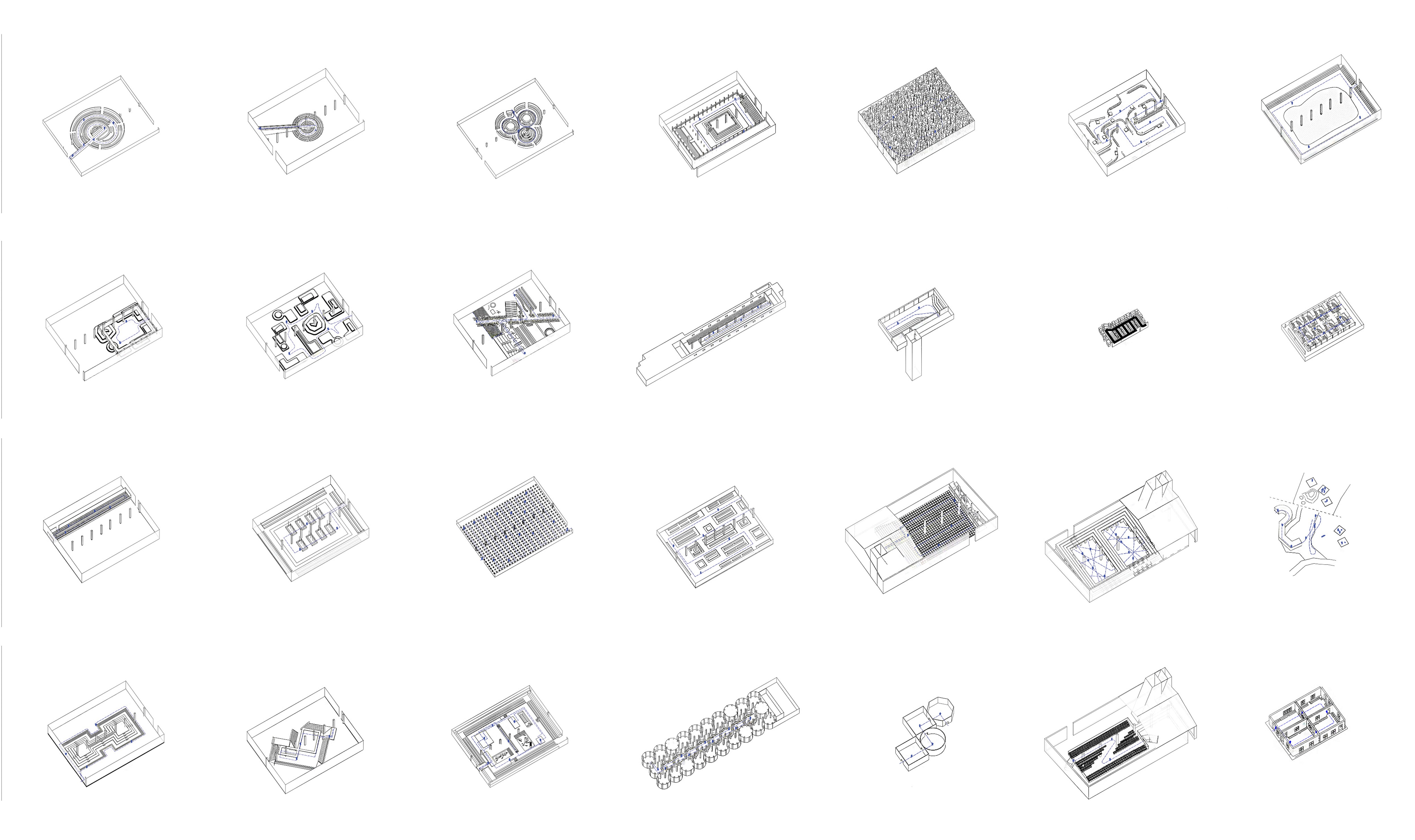
Show Diagrams

A RECURRING VOCABULARY
Across the projects examined, several spatial elements repeatedly appear: the grid, hill, wave, labyrinth, enclosure, tilted axis and appropriation of existing structures.
At first, these may appear to be recurring visual motifs. However, when the projects are compared systematically, they can be understood more productively as architectural operators.
The operator is not a form to be repeated. It is a spatial mechanism that can produce different relationships between body, audience and environment.
A hill can elevate, conceal or reveal.
A grid can organise, divide or restrict.
A labyrinth can interrupt linear movement.
An enclosure can control visibility.
A tilted plane can destabilise orientation.
An existing building can become both context and stage.
What remains consistent is therefore not the appearance of the set, but the logic through which space is manipulated.
This helps explain why the sets can be formally different while still belonging to the same architectural practice.
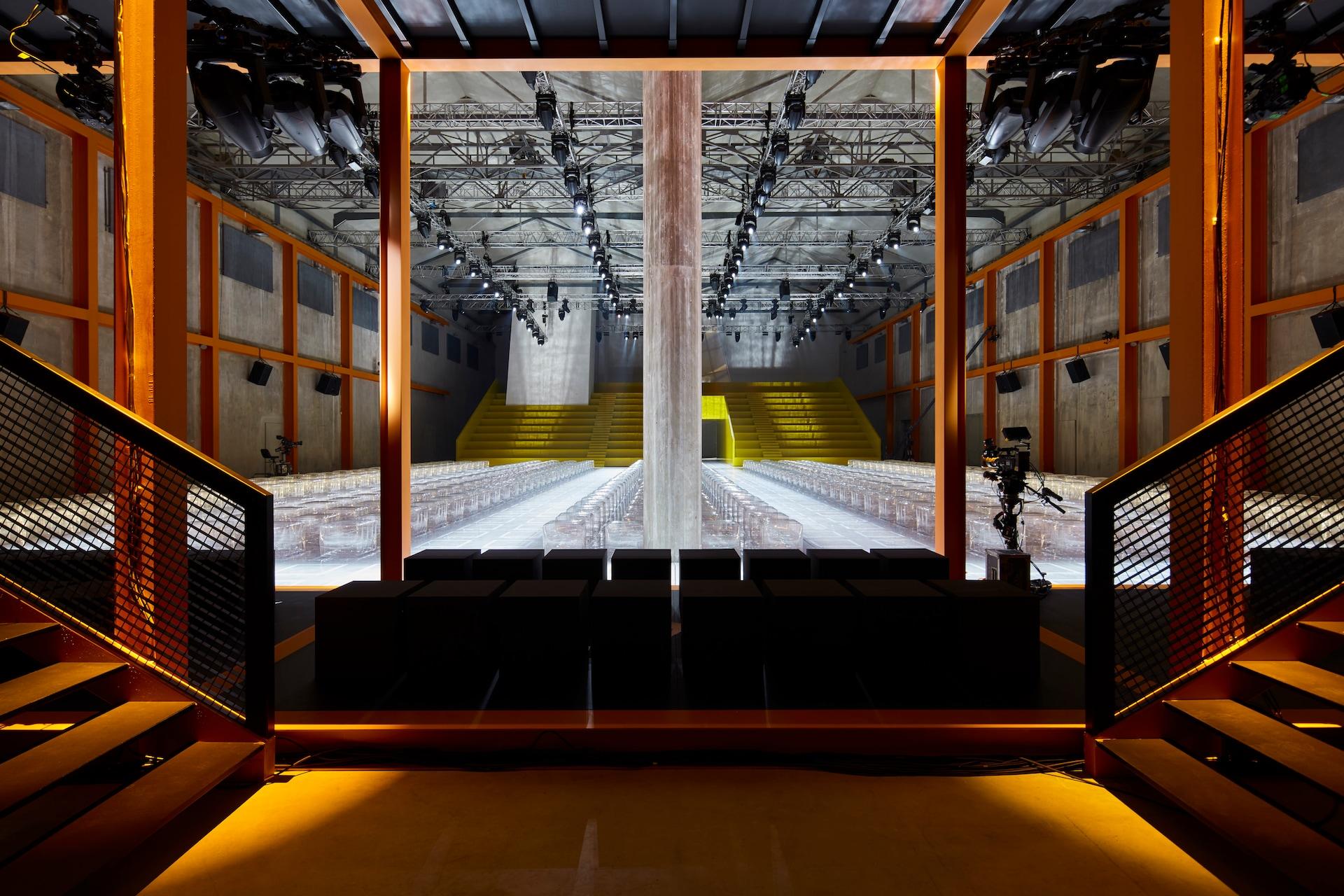
CARTESIAN THEATRE, S/S 2019 WOMEN’S FASHION SHOW
THE REVERSAL OF CONVENTION
A recurring strategy within this vocabulary is the transformation of something familiar.
The traditional runway establishes a relatively clear relationship: the model moves, the audience observes. The stage is separated from the spectators; movement follows a defined path; visibility is controlled.
OMA/AMO repeatedly questions these conventions.
A runway can become a landscape.
A theatre can become a field.
A warehouse can become a stage.
The audience can become part of the architecture.
A wall can become an obstacle, a boundary or a landscape.
The architectural intervention is therefore not necessarily about creating a spectacular object. It can instead be about reorganising the rules of perception.
The set becomes a device through which familiar relationships are reversed or made unfamiliar.
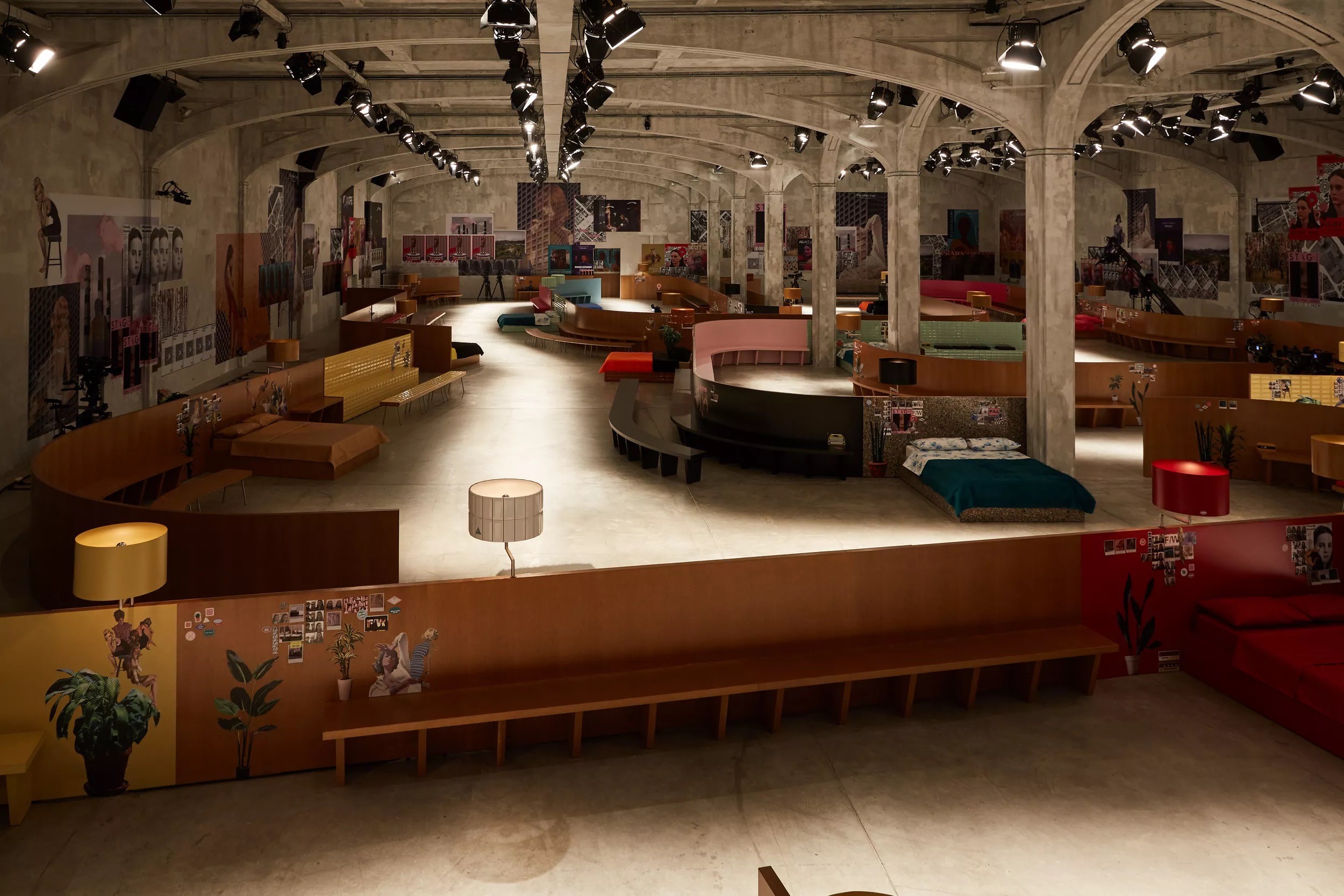
F/W 2017 WOMEN'S FASHION SHOW
CONTEXT AS A STRUCTURAL INPUT
The research also reveals that the cultural context surrounding a show can become embedded in its spatial organisation.
The financial crisis, changing ideas around visibility and gender, or the conditions of the pandemic do not necessarily need to be represented through literal imagery. Instead, they can be translated into spatial conditions such as confinement, separation, restricted movement, altered visibility or the absence of an audience.
In this sense, context becomes structural rather than decorative.
The architecture does not necessarily represent its cultural moment.
It absorbs it into the way space operates.
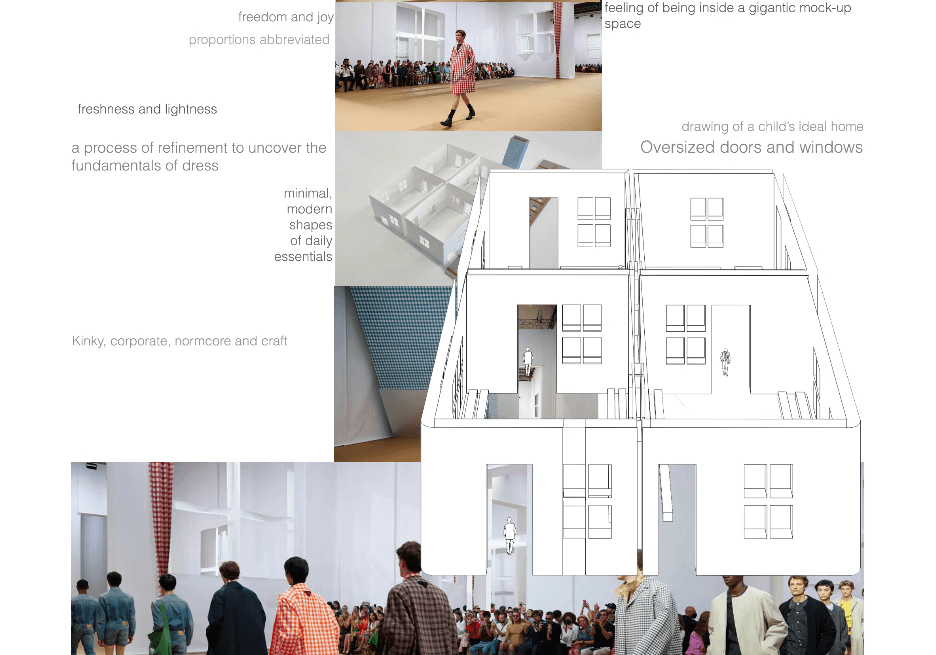
S/S 2023 MEN’S FASHION SHOW
CONCLUSION
Across different fashion shows, the forms change dramatically, yet a relatively stable vocabulary of architectural operations continues to reappear. Each new show becomes an opportunity to recombine these operations in response to a new collection, a new site, a new audience and a new cultural condition.
The set is therefore not simply a backdrop for fashion.
It is a temporary architectural laboratory.
A place where movement, visibility, audience, scale and perception can be tested; where architectural ideas can be explored at a different speed and where the identity of a brand can be constructed through spatial experience rather than visual representation.
The question of the fashion-show set consequently shifts from:
“What should the set look like?”
to:
“What spatial relationship should this brand create between the body, the audience, the object and its context?”
It is at this point that scenography becomes architecture, not because the set resembles a building, but because it begins to operate as an architectural proposition.
JOURNAL 01
PRADA × OMA/AMO
The Set as an Architectural Laboratory
Research: Fashion Shows / Scenography / Spatial Strategies / Temporary Architecture
PRADA FASHION SHOWS - F/W 2019 , F/W 2018, S/S 2023
